

|
Women
At The Table
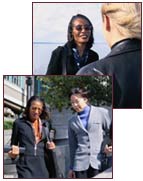
There is a shared desire by women of different skin tones, affiliations, and personal stories to under-stand how to develop a truly inclusive women's agenda. This was demon-strated by the well-attended gathering of the 'Women of the Millennium II' conference, a continuing dialogue about the future of the women's movement in a multiracial community. The March 26th event, sponsored by the Human Relations Foundation of Chicago and the Chicago Council on Urban Affairs, was a follow-up to a previous discussion about this subject. The distinguished multiracial panel of women included an African American college professor, two Hispanic women, one White and one Asian-American woman. With the exception of the professor, all the women were executive directors for various social coalitions. During her time to speak, each woman provided a candid perspective on the personal challenges and experiences of being a woman in the United Sates, but more specifically, being a woman of a particular race. Their comments illustrated in a real and honest way, how issues of race override other aspects of the bigger picture. This bigger picture or broader aspect of the women's movement is essentially gender inequality, and for most women of color, that issue comes behind the issue of race. Issues such as racial inequality, poverty, immigration and so on-issues it is believed are largely left out of the mainstream women's agenda. As a result, these groups felt excluded. And despite the gains for all women resulting from the movement, to women of color, white women have gained the most. Due to the unfortunate reality that race is the most polarizing issue for Americans, members within most racially-diverse groups seem to naturally gravitate towards their own, or even opposing, agendas. While moving towards the 'browning of America' (the prediction by experts that in the near future, whites in the United States will be a numeric minority), the women's movement will have to embrace a wider range of issues and concerns in the 21st century. Although this discussion focused on multiracial inclusion, the discussion was not limited to race. Whether they vary by religion, sexual orientation or physical capabilities, concerned women recognize the need to transcend superficial differences for the sake of humanity and are looking for ways to become partners. As with any situation where human beings are in disharmony, there is no one correct solution. But the willingness to admit that these conflicts exist, and then taking action with open and honest dialogue, creates the best chance of getting close to a solution. |
||
|
|
||